On the word Malaysia stopped insisting on
Great concessions in diplomacy are rarely announced. They are not signed at ceremonies, nor debated in chambers, nor conceded under visible duress. They occur instead in the quiet amendment of adjectives, in the removal of a qualifying clause from a sentence that few will read and fewer will compare against its predecessor, and they are discovered only when a later government finds that a position it assumed to be held has already been surrendered by a previous one.
The recognition instruments that Southeast Asian states signed with the People’s Republic of China in the 1970s were drafted by men who understood this precisely. Their grammar was deliberate. Malaysia, in the joint communiqué of 31 May 1974, recognised the Government of the People’s Republic of China as the sole legal government of China, and then, in a separate and carefully constructed clause, acknowledged the position of the Chinese Government that Taiwan formed an inalienable part of its territory. Thailand signed an almost identical construction the following year. One recognises a government, which is an act of state. One merely acknowledges what that government asserts about territory, which is an act of record. The distinction was not accidental, and it was not a courtesy extended to Taipei. It was the retention, by a small state, of the right to form its own view at a later date.
That distinction has now been abandoned across most of the region, but it has been abandoned unevenly, and the pattern of its abandonment tells us more about the governments concerned than about the pressure applied to them.
Thailand has conceded on the question of constitutional model. Its joint statement with China in July 2026 moved the claim into Bangkok’s own voice and added support for one country, two systems, which is a proposition not about title but about the machinery of absorption. Yet Thailand kept the word peaceful attached to reunification.
Singapore has conceded almost nothing, and the reason is instructive. It declined recognition until 1990, waiting deliberately until its neighbours had moved, and by arriving last it negotiated against a counterparty whose leverage was already spent. The communiqué it signed on 3 October 1990 contains no Taiwan clause of any description. A narrow sentence appeared in a joint statement in 2000, stating that Taiwan is part of China, without the word inalienable, without naming the People’s Republic as the holder of title, and without any reference to reunification. Since then Singapore has contracted rather than expanded, and it now issues no joint text at all, preferring separate readouts in which it states a clear and consistent one China policy and an opposition to Taiwanese independence. Beijing’s readouts of the same meetings use the word principle. Singapore has never asked for the two accounts to be reconciled, and it has never varied its own.
Malaysia has conceded on the question of method, and it is alone in doing so.
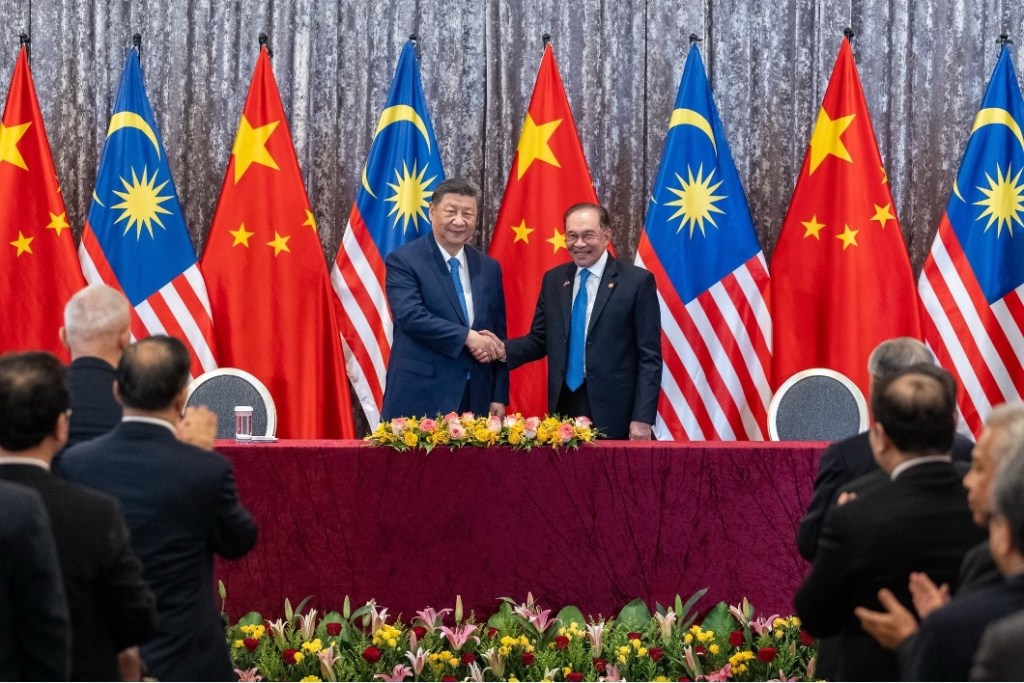
The second omission. President Xi Jinping and Prime Minister Anwar Ibrahim at Seri Perdana, 16 April 2025. The joint statement issued from this visit reproduced the formulation agreed in June 2024, and again without the word peaceful.
In June 2024, at the visit of Premier Li Qiang, the attributive clause of 1974 disappeared. Malaysia no longer acknowledged what China asserted. Malaysia recognised, in its own voice, that Taiwan is an inalienable territory of the People’s Republic of China, and undertook not to support any call for Taiwanese independence. Malaysian observers noted at the time that a word present in every previous bilateral document had gone missing: peaceful, which had always preceded reunification. In April 2025, at the state visit of President Xi Jinping, the same sentence was reproduced, and the same word was again absent.
The first omission may be attributed to haste. The second cannot. A word remarked upon in public and then dropped a second time has ceased to be an oversight and has become a text.
Malaysia’s is not the largest concession in the region, and the temptation to overstate would defeat the argument. Thailand went further on the constitutional question, and no Malaysian text endorses one country, two systems. But Malaysia is the only one of the three whose text places no constraint whatever upon the manner of reunification. Thailand retained the qualifier. Singapore does not address reunification at all and therefore has nothing to qualify. Malaysia named the People’s Republic as the holder of title, undertook a forward obligation of conduct, and said nothing about the means by which the outcome might be achieved.
Until 16 August it remained possible to read that silence as inadvertence, the residue of two ceremonial deadlines and a drafting table under pressure. That reading is no longer available.
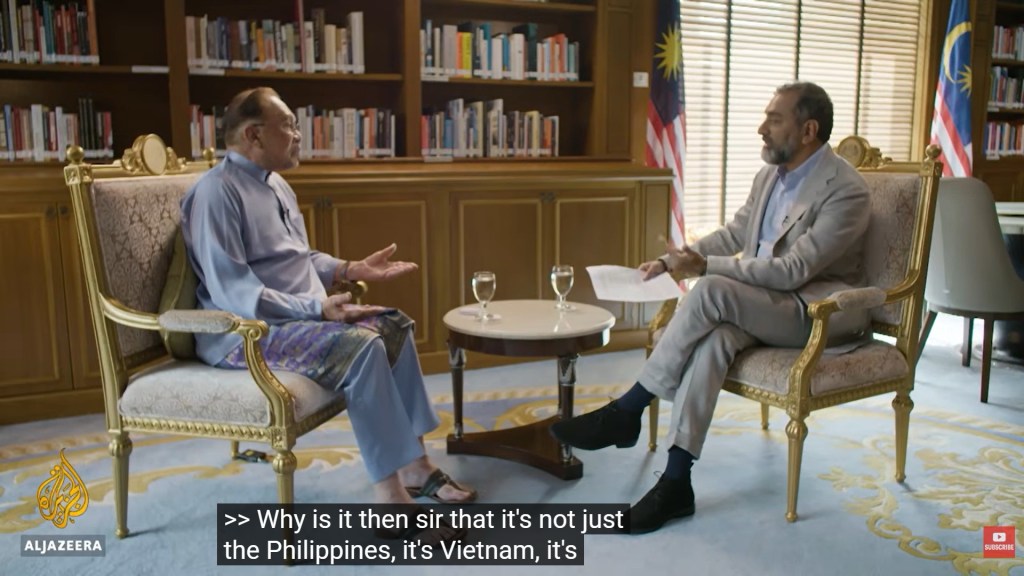
Prime Minister Anwar Ibrahim interviewed for Al Jazeera’s series on the contest for global power, broadcast 16 August 2026.
On that date, in a filmed interview for Al Jazeera’s series on the contest for global power, the Prime Minister was asked whether he would condemn China’s reserving the right to use force should peaceful reunification fail. Malaysia formed no part of the question. The Prime Minister introduced it himself, saying that he always takes Malaysia as his example, and asking whether force would be used were one province of this country to break away. He answered his own question in the affirmative, to protect what he described as the sanctity and unity of the nation. Asked to confirm, he confirmed, and supplied a reason, which was that the alternative was fragmentation.
An answer of that kind asserts a great deal more than a recognition policy requires, and it is not the position our predecessors held in 1974. It also explains the missing adjective. A government which regards the matter as internal has no occasion to qualify the means, because qualifying the means is what one does with respect to the conduct of others. The interview does not merely confirm the omission of the word peaceful. It supplies its logic.
Of everything a state may concede in this vocabulary, the qualifier on method is the one concession it cannot afford, because it is the only word in the sentence that speaks to the use of force. And it is a singular thing for a maritime claimant to surrender.
Malaysia occupies features in the Spratlys, has lodged a continental shelf submission, and faces a line drawn on a Chinese map enclosing waters this country has administered and drilled for decades. Neither Thailand nor Singapore has any comparable exposure. Thailand has no interest whatever in those waters. Singapore claims nothing there and takes no position on the sovereignty of any feature. Neither would pay any price for generous language, and both were careful regardless. Malaysia is the state among them with the most at stake and the one that has been least careful, which suggests a concession made by people who will not be the ones to pay for it.
Nor does that line fall on the peninsula. It descends across the shelf of Sarawak and Sabah. Luconia Shoals, where foreign coast guard vessels have maintained a near continuous presence for years, lies off the Sarawak coast. James Shoal, which Beijing designates the southernmost point of its national territory, lies off Sarawak. The gas fields that have drawn the most persistent and least publicised attention lie on the Sarawak shelf. The Malaysian features in the Spratlys are administered from Sabah. The only Malaysian maritime areas presently subject to a competing foreign claim lie off Sabah and Sarawak. The qualifier was given away twice in their waters, and on neither occasion were they asked.
Malaysia’s entire position in that sea rests upon a single proposition, which is that competing claims are not settled by coercion. It is the argument advanced in every consultation, the argument upon which the Code of Conduct negotiations depend, and the only argument available to a country that will never match the tonnage arrayed against it. A government that signs a text placing no limit on the means of reunification has weakened the credibility of the one sentence it cannot do without.
Bravado is inexpensive to the man who supplies it and dear to the state that must live behind it.
The question this raises is not whether Malaysia has tilted toward Beijing. That framing is convenient for both government and opposition, and it explains nothing. The question is whether the government of the day possesses a drafting discipline at all, or whether it accepts the counterparty’s preferred text as the price of a successful occasion.
The evidence suggests the latter, and the evidence is not confined to China.
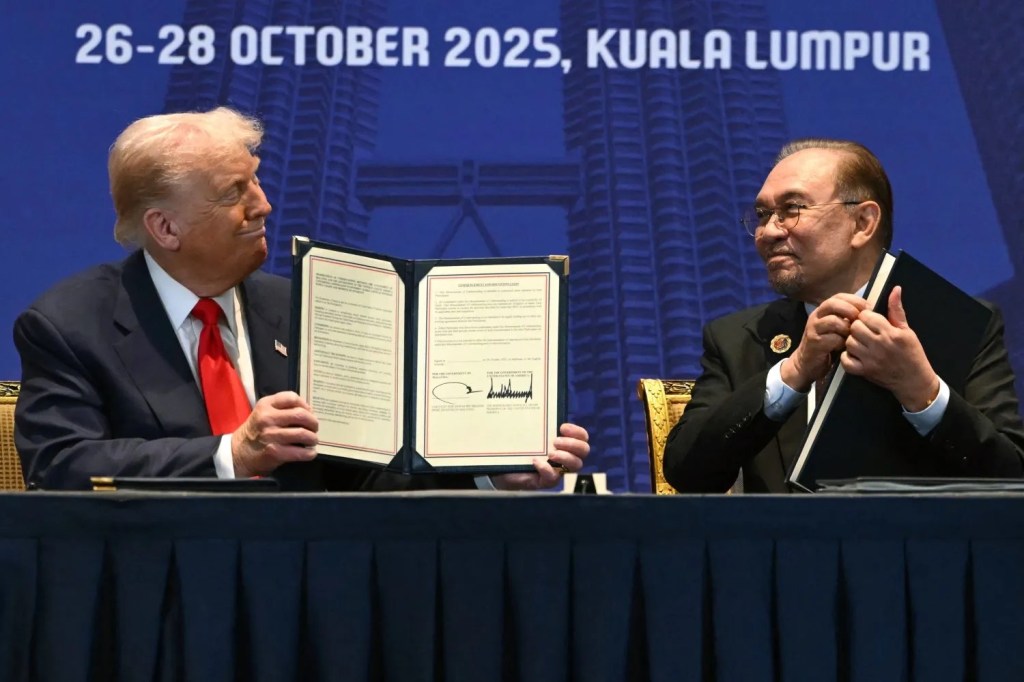
Purchasing good feeling. Prime Minister Anwar Ibrahim and President Donald Trump at the signing of the Agreement on Reciprocal Trade, Kuala Lumpur, 26 October 2025. The agreement remains unratified, and its provisions on sanctions alignment and on assistance to government linked companies have been contested since.
Eighteen months after the language on Taiwan was altered, the same administration signed the Agreement on Reciprocal Trade with the United States, concluded at Kuala Lumpur on 26 October 2025 during President Trump’s attendance at the ASEAN Summit. Its Article 5.1 has since been read as requiring complementary action in support of American sanctions. Its Article 6.2 has been read as bearing upon non-commercial assistance to government linked companies and, by extension, upon Bumiputera preference. It permits termination should Malaysia enter a preferential agreement judged to jeopardise essential United States interests, and it restricts the sourcing of nuclear fuel and reactors. A former Attorney General described it as the worst agreement entered into since independence. By January 2026 a new Minister was telling Parliament that the agreement remained unratified and that its looser clauses would require tightening before it could be.
The counterparties are opposed. The disposition is identical. In each case a text was accepted in the shape the other side preferred, at a moment when the occasion required a settled outcome, and in each case the difficulty surfaced only afterwards, when the words were read against those they had replaced.
This is not alignment. Alignment would at least be a strategy, and strategies can be defended in Parliament. This is something less considered: the treatment of language as the currency in which good feeling is purchased, on the assumption that words conceded in a communiqué are recoverable in a way that words conceded in a treaty are not. They are not recoverable. They accumulate. They are cited back. They become the baseline against which the next draft is negotiated, and each successive government inherits a smaller room in which to stand.
The word was not taken from Malaysia. Malaysia stopped insisting on it.
Warmth is produced in a single photo op. Position is surrendered quietly for a generation.
Datuk Omar Mustapha is Vice President of Parti Wawasan Negara and Chairman of its Economic Bureau. He chairs Room Capital.

