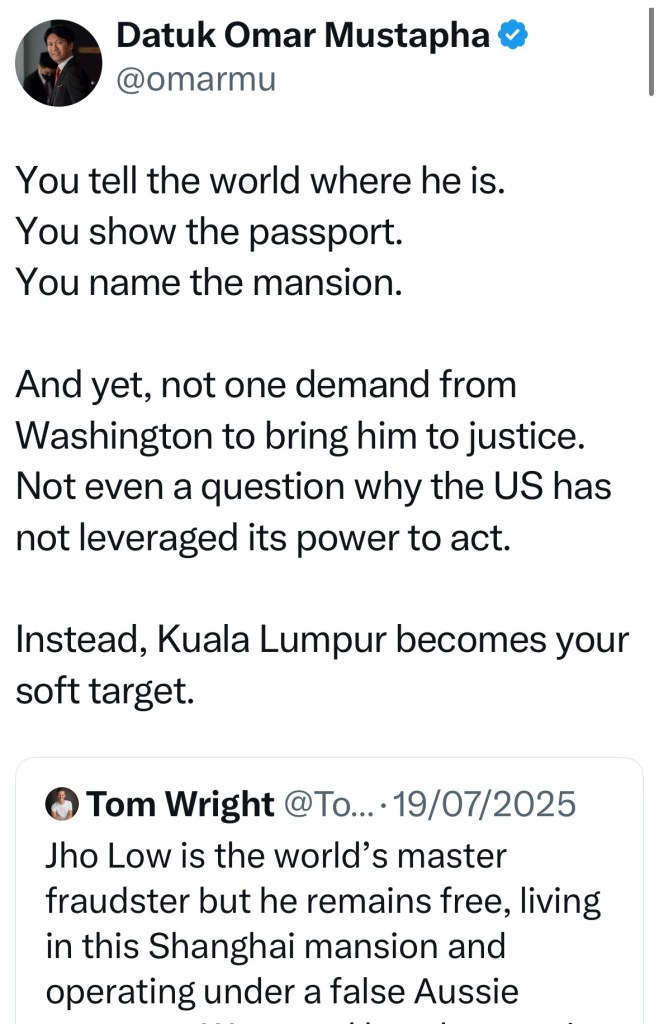
“You tell the world where he is. You show the passport. You name the mansion. And yet, not one demand from Washington to bring him to justice.”
That was the question I posed not in anger, nor in defence, but as a call for moral consistency. It was neither partisan in origin nor rhetorical in tone. It asked only this: if one claims to expose injustice, must one not confront it in every direction?
The responses that followed did not disappoint. They also revealed more than I had expected.
⸻
I. The Double Standard That Holds
Bradley Hope and Tom Wright were once praised for their early work uncovering the mechanics of the 1MDB scandal. Their reporting helped internationalise the narrative and frame Jho Low in the global imagination. The impact of their book Billion Dollar Whale was real and for that, they earned respect – and global attention.
But something fundamental has shifted in the years since. No longer reporters bound by institutional rigour, they now operate as brand custodians of a global content platform. Their posture remains investigative, but the substance has shifted. They have ceased to investigate power in all its forms and have begun to curate narratives in a way that is editorially convenient and commercially useful.
When they published a thread identifying what they claimed to be Jho Low’s false passport and mapped his villa in Shanghai, the implications were serious. The man at the centre of the world’s most audacious financial scandal is no longer hiding. He is living in plain sight. His location is not speculative. It is known. By them. By the Department of Justice. And most likely, by many others with the power to act.
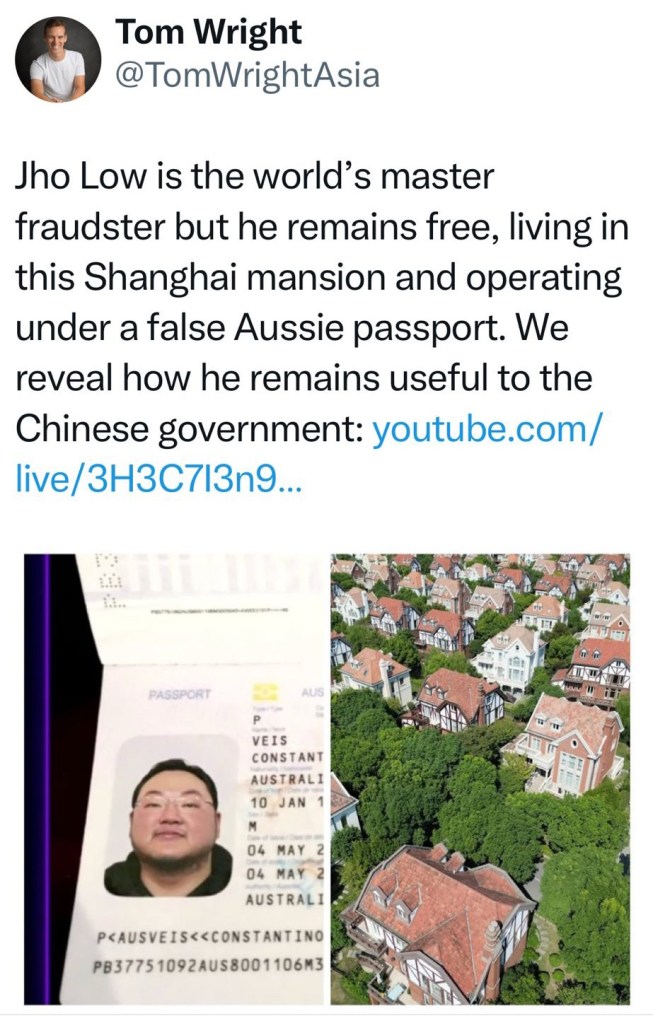
Tom Wright’s exposé of Jho Low’s alleged Shanghai location, complete with photo of a false passport and villa overhead.
But they did not direct their questions at Washington. They did not ask why no diplomatic action had been taken. They did not ask why the same country that located Osama bin Laden and retrieved him from a fortified compound halfway around the world appears unable (or unwilling) to bring Jho Low to justice.
Instead, they turned their attention once more to Malaysia.
⸻
II. A Deflection Disguised as Precision
I engaged. Politely. Transparently. I asked whether any pressure had been applied by those in Washington who have jurisdiction over Jho Low, who indicted him under U.S. law, who recovered billions in stolen assets, and who benefitted from the extradition of a Malaysian citizen to stand trial in their courts.
Tom Wright replied, “He’s Malaysian.”
As if that settled the matter. As if that absolved the United States of responsibility. As if jurisdiction were a matter of birthplace, rather than binding law.

Wright’s reply to my public query on U.S. inaction: “He’s Malaysian.”
A three-word shrug.
Before I published this post, I had asked a quieter question in a different context, prompted not by provocation but by something I could not ignore. Bradley Hope had shared a visually intricate map of the 1MDB scandal, intended to show the complex web of individuals and institutions involved. But two nodes were blacked out. They were not banks or jurisdictions. They were names. And they were names that, from what could be discerned, pointed not to Malaysian actors, but to figures associated with the Trump campaign.
I noted this publicly, not to accuse, but to observe. Hope responded with civility and restraint. Tom Wright, by contrast, dismissed the comment altogether. “This guy accusing us of something? Hard to understand.”
That reaction was instructive. The discomfort did not lie in what was said, but in what had been seen. The redactions were not accidental. They were deliberate choices. And those choices revealed that the story, at least in part, was no longer being told in full.
At that moment, it became clear to me that we were no longer dealing with journalism in its purest form. We were witnessing its transformation into something else: selective narrative, editorial control, and ultimately, performance.
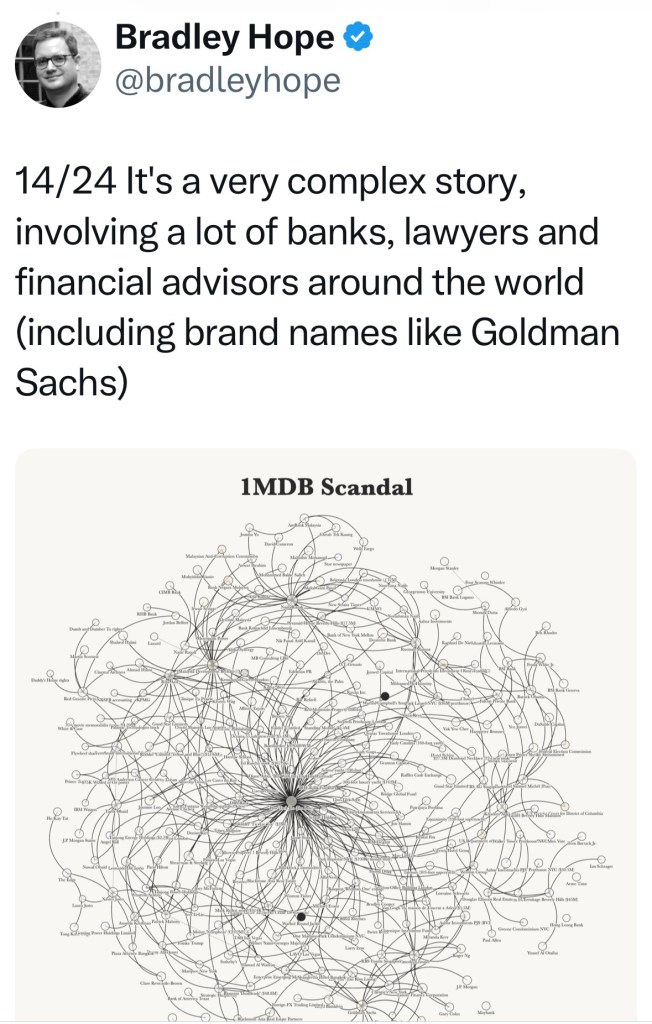
Bradley Hope’s own visual reconstruction of the 1MDB scandal. Amid the many connections mapped, two names are redacted—despite the public domain record of their involvement. The omissions are not editorial oversights. They are deliberate narrative choices.
Roger Ng is also Malaysian. He was arrested, flown over ten thousand miles, and tried in Brooklyn. He was handed a ten-year sentence by a U.S. federal judge. His citizenship did not shield him. Nor should it have.
Malaysia prosecuted its former Prime Minister who was found guilty and is now imprisoned. Malaysia cooperated fully with the DOJ. Malaysia bore the political cost of reform and accountability. Malaysia has never denied its institutional failings.
But it is not Malaysia that knows where Jho Low is today. It is not Malaysia that holds the legal indictment under its own statutes. It is not Malaysia that possesses the geopolitical tools to act, and yet has chosen not to.
⸻
III. The Descent from Journalism to Franchise
And then came the real reveal.
On the same thread that identified Jho Low’s alleged location, just beneath the investigative claims, appeared a link.
“Jho Low World Tour. 2009–2025.” Printed on a black T-shirt. Available for purchase. Promoted on the same account. Branded under the same media studio.
This is not journalism.
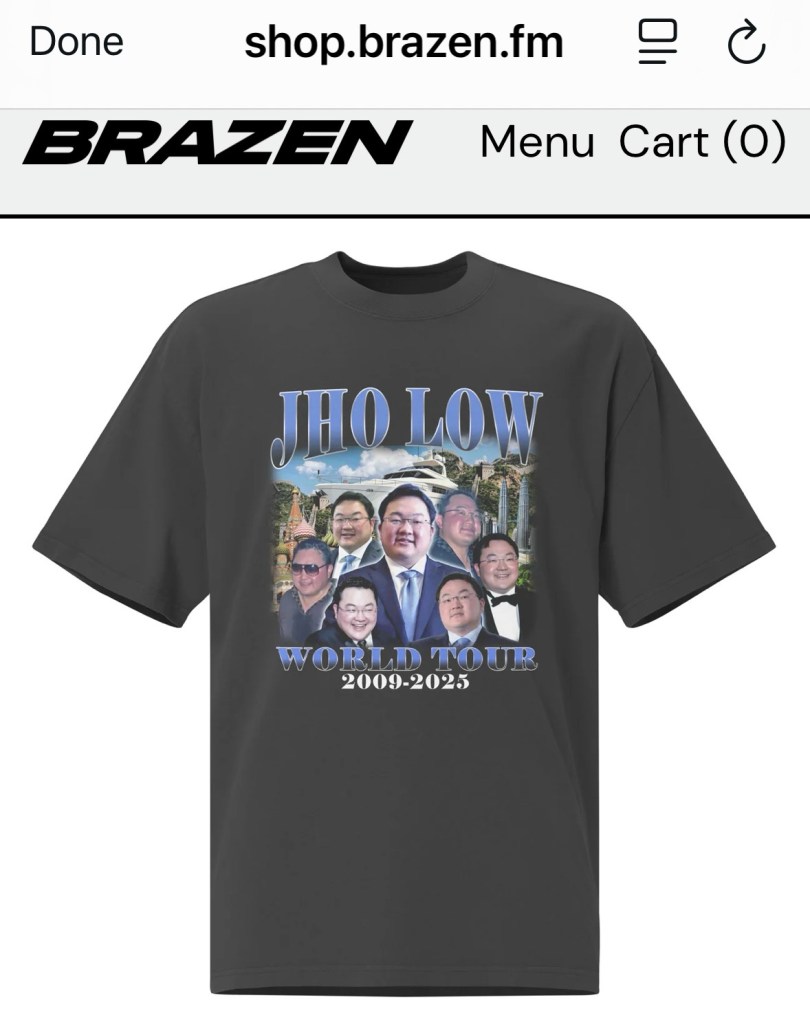
A novelty T-shirt marketed by Brazen.fm bearing Jho Low’s image and the label “World Tour 2009–2025.” Promoted on the same platform used to expose his whereabouts, the product blurs the line between justice and merchandising.
This is merchandise created in the likeness of a man they claim to hold responsible for the worst act of financial pillage in Malaysia’s history. It is difficult to reconcile that moral posture with the decision to commercialise it on a novelty shirt.
No serious journalist at The Wall Street Journal, where both men once worked, would imagine monetising their reporting in this way. No Pulitzer-winning newsroom would permit it. And no editor of integrity would defend it.
And yet, here we are.
When those who once chronicled justice begin to sell the image of the fugitive they helped immortalise, it no longer matters what they say about others. Their actions have become the story.
⸻
IV. What This Is Actually About
Let me be clear. This is not a defence of Najib Razak. It is not a partisan diversion. It is not a plea for absolution.
I testified under oath. I submitted myself to legal scrutiny. I do not need to re-litigate that here.
But I will not remain silent when others who once stood for accountability begin to insulate themselves from it. If you invoke the language of justice, then you must be prepared to answer to its demands. If you trade on the authority of journalism, then you must accept the responsibilities that come with it. You cannot hold others to account while evading scrutiny yourself.
Nor can you condemn a small nation’s failings while averting your gaze from the silence of superpowers.
Malaysia has many flaws. We have paid a price. We continue to pay it. But we have never protected Jho Low.
The country that knows where he is and chooses not to act is not Malaysia.
⸻
V. Final Observations
This is no longer a story about a fugitive alone. It is a story about those who now curate his narrative, profit from his notoriety, and offer judgment from a safe and selective distance.
It is also a story about what journalism becomes when it crosses the line into performance. When truth is no longer pursued for its own sake, but tailored for spectacle and tailored to sell. When T-shirts replace testimony.
If Tom Wright and Bradley Hope wish to become public commentators, then they must accept public scrutiny. If they choose to market their reporting as a product, they must also accept the consequences of commodifying justice.
I would not have written this if they were mere provocateurs. But they speak from the prestige of institutions they once served with distinction. They should carry that weight with honour.
Because if they will not bear that responsibility, others must.
Postscript:
Once, they chased the story.
Now, they sell the narrative.
From watchdogs to showrunners, the transformation is complete.
 Musings of the (occasional) thinker; planner; do-er
One response to “When the Storyteller Becomes the Story”
This piece has more insight than the entire billion dollar whale saga
LikeLike