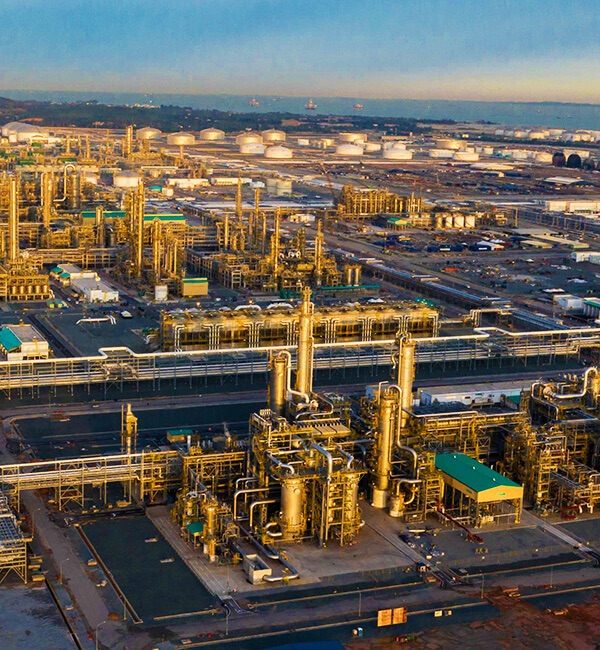
The Refinery Complex and selected petrochemical plants are owned and operated by Pengerang Refining Company Sdn Bhd and Pengerang Petrochemical Sdn Bhd (collectively known as PRefChem), a joint venture between PETRONAS and Saudi Aramco.
Large industrial undertakings are rarely judged accurately in their own time. The decisions that bring them into existence are taken under conditions of uncertainty that only become fully visible years later.
The present moment provides a stark reminder. The war now unfolding across the Middle East involving Iran, Israel, the United States and the Gulf states has begun to fracture the energy arteries of the global economy. Tanker traffic through the Strait of Hormuz has been disrupted, infrastructure across the Gulf has come under attack and supply chains that once appeared stable have suddenly become fragile.
Looking back now, the RAPID development belongs to that category of decisions whose true significance only becomes clear much later.
It has been nearly eight years since I left the Tower. Yet when headlines once again speak of energy supply disruptions, the mind returns instinctively to that boardroom on the eighty fifth floor.
Between 2009 and 2018, a single undertaking dominated our deliberations. The language of the time spoke of reimagining energy. In reality, the task before us was more elemental. We were establishing a durable industrial position in anticipation of a far more volatile global energy system.
When RAPID was officially launched in 2012, the ambition was considerable. The intention was not merely to construct another refinery but to establish a high conversion refinery integrated with petrochemicals, one of the most sophisticated industrial systems in the region, with a Nelson Complexity Index of 12.03. The capital commitment, ultimately approaching US$27 billion across the complex, reflected the scale of that ambition.
The location itself reflected a strategic logic that few sites in Southeast Asia could replicate. The coastline possesses a natural deepwater draft of roughly twenty four metres capable of accommodating the largest crude carriers in the global fleet. At the same time the site lies in close proximity to Singapore, the region’s dominant refining and trading hub. The objective was therefore not to create an isolated facility, but to establish a Malaysian industrial platform operating alongside one of the world’s most sophisticated energy trading ecosystems.
Events soon imposed a more disciplined perspective.
The collapse in global oil prices in 2014 forced a reassessment of the project’s financial assumptions. By the time discussions with Saudi Aramco gathered momentum in 2016, the strategic calculus had become clear. Their seven billion dollar investment was important. Their long term crude supply was indispensable. Without a secured feedstock partner, the resilience of the complex would remain exposed.
Early 2017 introduced a moment of genuine uncertainty. There were reports that Aramco was reconsidering its participation and rumours of an exit circulated during those weeks. Their technical teams had become increasingly direct in their assessment of the project’s trajectory. For a company accustomed to leading projects of global scale, participation in a complex already experiencing delays understandably raised questions.
The partnership ultimately held. King Salman’s visit to Malaysia in February 2017 provided the moment at which the relationship stabilised publicly. Yet the experience served as a reminder that projects of this scale are sustained not only by capital but by continued confidence between partners.
Recent developments across the regional energy system have brought another aspect of the project’s design into sharper focus.
Several refining and petrochemical facilities in Southeast Asia have declared force majeure as supply chains tighten. Many petrochemical plants operate as standalone facilities dependent on purchasing naphtha from external refineries. When refinery output contracts or shipping routes fracture, the feedstock simply does not arrive.
In such circumstances industrial capacity becomes irrelevant.
Pengerang was deliberately designed on a different basis. The refinery and petrochemical units operate as an integrated system. Naphtha produced by the refinery is transferred directly to the petrochemical complex through captive internal pipelines. What appears in ordinary times as efficiency becomes, in moments of disruption, a vital form of resilience.
Beyond molecular integration the complex was designed with a high degree of operational autonomy. Core utilities including power generation and water supply were developed alongside the industrial units themselves. This ensures that critical operations remain insulated from disruptions affecting external grids or municipal systems.
Taken together these design choices created something more than a conventional refinery complex. Pengerang was conceived as a largely self contained industrial ecosystem capable of sustaining operations even when surrounding supply chains come under strain.
The refinery was also configured with a high degree of feedstock flexibility. While long term supply from Saudi Aramco provides the backbone of operations, the processing configuration allows a range of crude blends from light sweet to heavier sour grades. In practical terms this means that if shipments of Saudi crude are delayed, alternative blends including indigenous Malaysian crudes can be incorporated without materially disrupting operations.
Another design decision has also proved consequential.
The present closure of the Strait of Hormuz has forced crude tankers to abandon their traditional twelve day route through the Gulf. Saudi crude will have to pass 1,200km across the Arabian peninsula via pipeline instead before being shipped through the Red Sea.
Under such conditions logistics matter greatly.
Many regional ports cannot accommodate the largest crude carriers without expensive offshore lightering. Pengerang, by contrast, was developed around its natural deepwater draft. The terminal can receive fully laden Very Large Crude Carriers carrying roughly two million barrels of crude. When voyages extend across thousands of miles of ocean, the economies of scale provided by such vessels are the only way to materially reduce the distance tax of long distance supply.
Design decisions that once appeared technical now reveal themselves as strategic.
Viewed from March 2026 the perspective shifts once again. The weak conversion margins experienced in 2024 appear far less significant when set against the present context of geopolitical disruption and constrained supply chains. Under such conditions the primary measure of value changes.
The most valuable integrated complex is no longer simply the most profitable one.
It is the one that remains operational.
Despite the delays, the commissioning incidents of 2019 and 2020, and the difficult early years, the Pengerang complex today continues to process roughly three hundred thousand barrels of crude per day.
The petrochemical units at Pengerang draw naphtha directly from the refinery’s internal stream rather than competing for cargoes in an increasingly constrained market.
RAPID was never intended to be merely a refinery project. It was conceived as a strategic industrial position within the regional energy system, one capable of remaining operational even when the world’s arteries fracture.
The expectation in 2012 was that the future of energy would be volatile.
War has now provided the test that matters. On that measure, the judgment made then still stands.
 Musings of the (occasional) thinker; planner; do-er