Political speechwriting is a craft where a scribe of modest talents attempts to marshal a leader’s flow of thoughts, ideas and arguments, weaving them into a narrative arc of words and sentences that ultimately convey purpose, meaning and emotions to a discerning audience.
Ben Rhoades, President Barack Obama’s closest speechwriter who served as his Special Assistant and Deputy National Security Adviser said this:
“If you are a speechwriter, you have to know what the person you’re writing for thinks. A lot of foreign policy advisers are thinking: how can I get my proposal into this guy’s speech? I was just thinking: what does he want to say?”
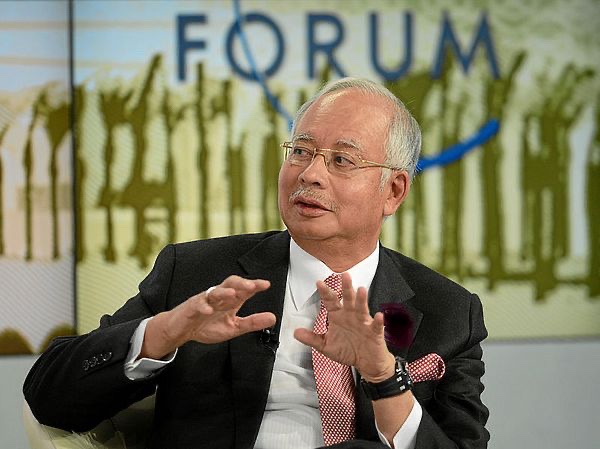
Ben was spot on. Dato Sri Najib Razak always knew what he wanted to say. My role was simply to figure out the best way he should say it.
I am proud to have once served Najib as his principal English speechwriter and Special Assistant to the Deputy Prime Minister from 2004 to 2006. We laboured over many speeches together, over the many years since I was first introduced to him in the late 1990s. This was one of them. In the present day context of the ongoing Russian war against the Ukraine, and the very real threat of military conflict over Taiwan, it is worth recalling Najib Razak’s reminder some 18 years ago.
Global Peace Forum
Putra World Trade Centre
Kuala Lumpur
17 December 2005
[Remarks by YAB Dato Sri Najib Tun Razak, Deputy Prime Minister of Malaysia]
YABhg Tun Dr. Mahathir Mohamad
Honorary President, Perdana Leadership Foundation
YABhg. Tun Dr Siti Hasmah Mohamad Ali
Excellencies
Distinguished Guests
Ladies and Gentlemen
- Allow me to begin by thanking YABhg. Tun Dr Mahathir and the Perdana Leadership Foundation for inviting me to close this forum. I am not only extremely delighted to be here, but also deeply honoured that I am able to join such a distinguished gathering of individuals, to champion and give voice to humanity’s greatest and most elusive goal: the simple desire for peace.
Ladies and Gentlemen
- The 1899 Conference for Peace was the first major international gathering in history dedicated solely to peace as a desirable end in itself. As if to test our seriousness of intent, we have instead borne witness to one of the most violent periods in human history. The two World Wars, the Vietnam War, the Korean War, the Cambodian War and countless other conflicts where governments have waged war against their own people. Where tribe has fought against tribe. One race against another. People of one religion against believers of another. More than one hundred years on, we are gathered here in Kuala Lumpur to once again seek that peace that continues to elude the vast majority of humanity.
- In the aftermath of the Second World War, the United Nations, and in particular its Security Council, was entrusted with the prevention of war and the building of peace. We placed great hopes in multi-lateralism. We believed the overwhelming weight of world opinion would dissuade those intent on violence and aggression. We believed that no matter how inequitable the Security Council may have been in its construct, it could at least guarantee that the world’s most powerful nations would come together, and act as a check and balance against the possibility of war. Judging by the track record of the last 50 years, our only conclusion must be that the multilateral approach has been only partially successful. We can minimise conflict between small countries. We can check the aggressive actions of some larger nations. But we are powerless when it comes to countries that are either very powerful, or have powerful friends.
- As the 20th Century drew to a close, we found that the world was still a dangerous place. Palestine. Kashmir. Afghanistan. Congo. Rwanda. Somalia. Kuwait. Kosovo. Iraq. These nations are etched into our collective human consciousness: evidence of our failure to prevent the continuing waves of violence and human suffering. Despite the earnest efforts of the global community, the 20th Century ended no better than how it started: as a vast stain of red on the chronicle of human history.
- Given this bleak picture, how then shall we all go about translating the deep and basic desire for peaceful resolution of our differences? Is there a road map for peace? We must believe there is still hope. There are many practical ways in which peace loving peoples and governments around the world can act to promote a culture of peace. But it is my firm belief that we must also attack the very theoretical foundations of those who promote war as a means to achieve peace. We must protect the moral high ground for peace which they seek to claim for war.
- The world will never have lasting peace so long as men reserve for war, the finest human qualities. Peace, no less than war, requires idealism and self-sacrifice and a righteous and unwavering faith.
Ladies and Gentlemen
- As a starting point, we must de-legitimize the use of force by one country against another. Let me make it clear that I am not advocating that we give up the right to arms. Governments have the responsibility of building a robust defence capability. Every country has the right to self-defence, to protect life, liberty and property within its own borders. But in the absence of a world government or a willingness to surrender rights to a regional grouping, national sovereignty must remain sacrosanct and be the basis of interstate conduct. No country, no matter how high it perceives its moral standing, no matter how legitimate it feels its cause, no matter how certain it is of its military capabilities, can inflict war on another country as the means to protect its self interest, or that of the world.
- This forum has rightly called for an organised, global movement to encourage ordinary citizens to vote for peace and reject war. As government leaders across the world, we should sit up, listen carefully and take heed. In history, we know that the decision to go to war is taken by either a single powerful individual or a group of powerful individuals acting in concert. Throughout the ages, war has been waged by dynastic monarchies, ruthless dictators, military juntas, and even freely elected Prime Ministers and Presidents.
- However, in all these instances, there has been no vote, no referendum, no avenue to ask the most obvious constituent the most obvious question: citizens, do you want us to go to war? Ordinary people everywhere have not been given the right to decide whether to put at risk the lives of their finest young men and women, and to take the lives of other fine young men and women in far away places.
- It is far too naïve to expect dictators to consult with citizens on going to war, but can we not expect this of democracies? If people in the free world have the time to vote for their national idols according to the quality of their singing, if they can decide whether or not to impose the death penalty on their citizen criminals, why can they not be given the moral choice to decide whether to inflict certain death on innocent people abroad? Perhaps it is high time to allow intelligent voters, in democratic countries, to exercise their veto each time their government decides to go to war outside their own borders. We certainly have the technology and the ability to do this efficiently today. “Veto War” should become the rallying cry that humanity brings to every village, every community, every city, every government around the world.
Ladies and Gentlemen
- Our next priority must be to adopt a more holistic, balanced approach in our common pursuit of freedom. Freedom today has become too narrowly defined – unfortunately we have developed a truncated view of this noble quality. At the end of the Second World War, President Roosevelt spoke eloquently about the four essential freedoms that would secure peace. Let me quote him because his words ring true even more so today: “The first is freedom of speech and expression – everywhere in the world. The second is freedom of every person to worship God in his own way – everywhere in the world. The third is freedom from want – which means securing for every nation a healthy peacetime life for its inhabitants – everywhere in the world. The fourth is freedom from fear which means a worldwide reduction of armaments to such a point and in such a thorough fashion that no nation will be in a position to commit an act of physical aggression against any neighbour – anywhere in the world”.
- Roosevelt was right. Freedom is not just about democracy. It is also about religious tolerance and mutual respect. It is about eradicating poverty and ensuring prosperity. It is about collectively forsaking war and the “tools of war” as a legitimate instrument of foreign policy. Not just in the dark recesses of the Third World, but also among the enlightened First World.
- The Malaysian experience has taught us the wisdom that each country must be given the unequivocal right to pursue these freedoms in the order and at the speed that is appropriate to their individual history and particular circumstance. The desire for peace is far more resilient and universal than we think. History shows we need not use the force of war to give it full expression. Let me repeat this: We need not use the force of war to give freedom its full expression.
- There was a time when we understood this. The Marshal Plan for Europe after World War Two built the foundations of prosperity that would serve as a bulwark against tyranny and oppression. Allied Forces played a vital and welcome role in the reconstruction of Europe. The Peace Corps brought Americans outside of their comfort zones, to see how the other half of humanity lived – their contributions in education, in poverty reduction, in introducing new skills – resonate even today as a testament of the goodwill once shown by the good people of the United States of America. This was the soft power approach that the world welcomed, and one to which we must return.
- If it is true that democratic states generally do not make war on each other, we must ask why we seem to have less hesitation waging war on undemocratic ones. To those who point to the progress achieved in Iraq and Afghanistan, let me remind you also of the progress we have achieved in the former Soviet Union, in a reunified Germany, in the post-Velvet Revolution Czech Republic, in post-Apartheid South Africa, in recent Indonesia. It was Margaret Thatcher who drew our attention to the fact that Ronald Reagan won the Cold War without firing a shot. It was not war but the human spirit that acted as handmaiden to the birth of democracy in these countries.
- Malaysia’s own experience in UN peacekeeping and in humanitarian relief work by our armed forces and NGOs, have shown us that the values of freedom need not be furthered through the barrel of the gun. The humble shovel, the stethoscope, the water purifier, human compassion are no less powerful instruments for freedom and for peace.
Ladies and Gentlemen
- Our third endeavour is not directed at governments, but among ordinary peoples. To the proverbial man and woman on the street, we must convince ourselves to recognise that the most direct, real, undiscriminating threat to peace today – the scourge of terrorism – cannot be addressed by force alone. The purveyors of international terror run no governments, control no territory, command no armies. We are fighting an unseen enemy; a vengeful phantom menace that is shapeless and amorphous. Their foot soldiers are the dominated minds of ordinary people.
- But let us be warned. If we choose to bomb terror into submission, we will fail. If we choose to insult them into seeing the errors of their ways, we will fail. If we choose to respond to their hatred with more of our own, we will fail. If we choose to be blind to the legitimate grievances behind their illegitimate actions, we will most certainly fail. I am reminded of the saying, “if the only thing in your hand is a hammer, everything will look like a nail”.
- “True, lasting peace cannot be secured through the strength of arms alone. Among free peoples, the open exchange of ideas ultimately is our greatest security”. These were the words of an American President (Reagan). I would add that it is not only among free peoples that we have to exchange ideas. It is also among the un-free, the dispossessed, the poor, the illiterate, all around the world, with whom we must enter into honest dialogue, make concessions and even agree to disagree.
- We must seek to rebuild humanity’s respect for one another. There is a verse in the Holy Quran which enjoins men and women to know each other, for that is the purpose God created us of different creed and colour.
- History allows us to state with certainty that our future must be based on the culture of peace and dialogue between civilisations. Let us be persevering. Let us prepare our children to express dissent without violence, to be different but united by the values and universal principles of justice, of tolerance, of freedom, of equity, of solidarity. Let us not only learn foreign languages, but also appreciate the foreign-ness of the thinking behind the people who speak them.
- We have paid the heavy price of war and violence. How soon the culture of peace will replace the culture of war depends on us: On our convictions about the need for these changes. On our determination to achieve this goal. On our willingness to surrender the logic of force and embrace the force of reason. Only then can we hope for a culture of peace, dialogue and non-violence. Let us abolish war before it abolishes us. Let us all work together to make this happen. And let us not take another hundred years.
Thank you.
 Musings of the (occasional) thinker; planner; do-er